
Unpromptd Team
India's 26x Programmatic DOOH Gap: A Wake-Up Call or a ₹8,000 Crore Opportunity?
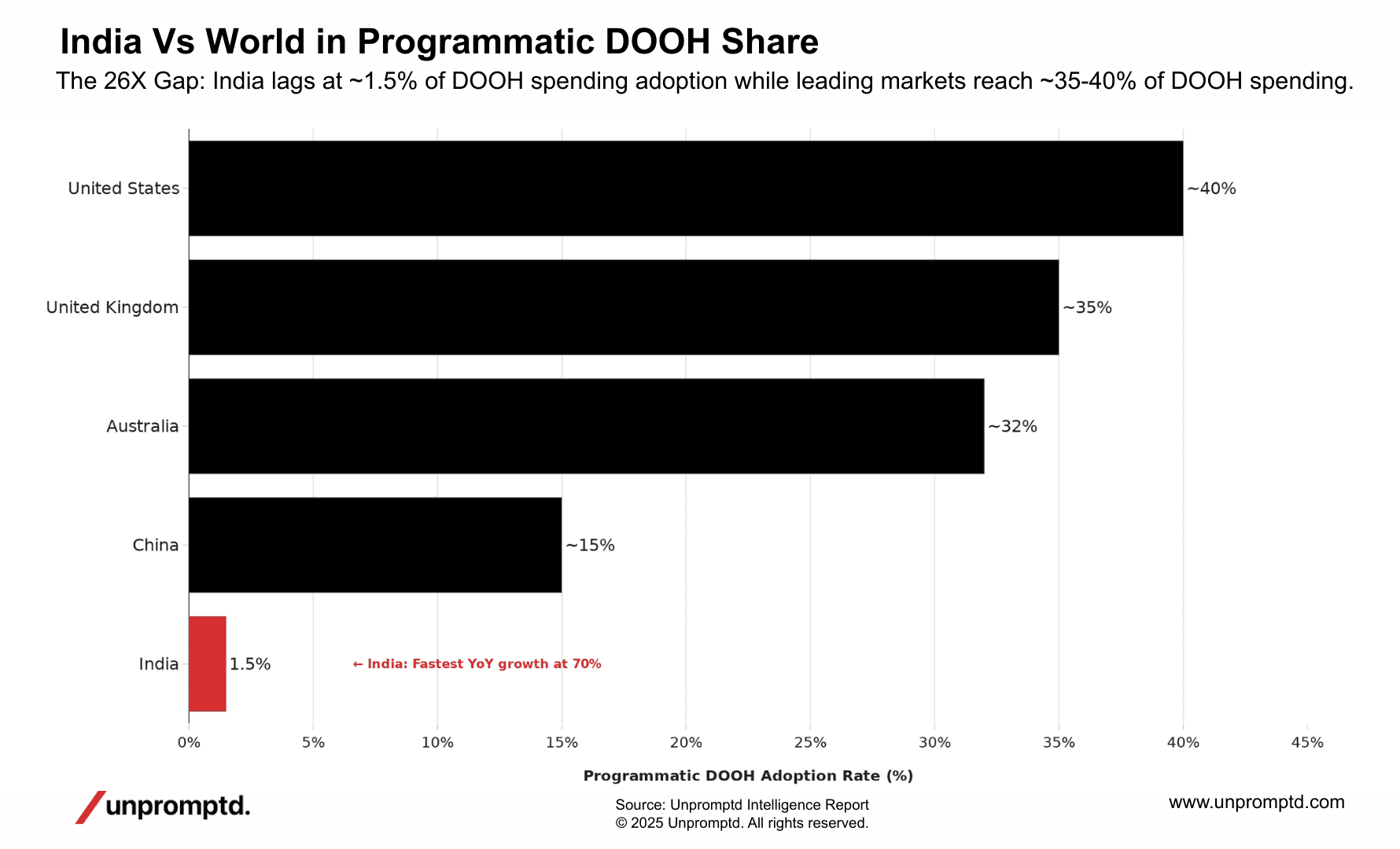
While global advertising markets are racing ahead with programmatic Digital Out-of-Home (DOOH), India finds itself at a curious crossroads sitting at just ~1.5% programmatic DOOH adoption when markets like the US, UK, and Australia have already crossed 32-40%.
That's not a typo. It's a 26x gap.
But here's the question every advertiser, agency, and media owner should be asking: Is this a problem or the biggest arbitrage opportunity in Indian advertising right now?
The Numbers Tell a Story of Extremes
India's overall OOH market is projected to reach ₹8,000 crore by 2026, growing at a robust 30%+ CAGR. DOOH's share within that pie is expected to hit 30-40%, up from just 10% a few years ago. Yet programmatic DOOH the automated, data-driven, real-time buying and selling of digital outdoor inventory accounts for barely 1-2% of the overall OOH spend.
Compare that to:
- United States: ~40% programmatic DOOH adoption
- United Kingdom: ~35% adoption
- Australia: ~32% adoption
- Brazil: Fast-growing LatAm markets pushing adoption aggressively
- India: ~1.5%
Globally, over a quarter of all DOOH campaigns now include a programmatic component, and that figure is projected to rise to 35% within 18 months. India, meanwhile, is still stuck in the relationship-driven, manual negotiation era of OOH buying.
Why the Gap Exists: The Infrastructure Reality Check
The lag isn't about demand. It's about three structural bottlenecks:
1. Fragmentation at Scale
India has over 300,000 digital screens, according to IOAA estimates. But there's no programmatic platform that aggregates even 25% of these screens. Without aggregation, programmatic buyers can't access meaningful scale, and without scale, they can't justify shifting budgets from traditional OOH or other digital channels.
2. The Mindset Moat
Media buying in India's OOH ecosystem remains deeply relationship-driven. Direct negotiations and personal connections still dictate pricing and inventory allocation. This isn't inherently bad; it's how the industry has operated for decades but it creates inertia against tech-enabled, transparent buying models.
3. Low Awareness and Missing Measurement
Programmatic DOOH requires standardized measurement metrics things like foot traffic attribution, dwell time analysis, and cross-channel retargeting. India lacks the widespread availability of these tools. Add to that low advertiser and agency awareness about what programmatic DOOH can actually do, and you have a classic adoption barrier.
But India Is Growing at ~70% YoY
Here's where the story gets interesting.
While India's current adoption sits at just 1.5%, it's growing at approximately 70% year-over-year, one of the fastest growth rates globally. That's not just organic growth. That's structural transformation in motion.
Why the acceleration?
- Infrastructure buildout: JCDecaux-VIOOH partnerships are bringing SSP integrations to India. Airport, metro, and mall digital screens are going live with programmatic capabilities.
- Category demand: BFSI, auto, real estate, Q-commerce, and D2C brands are pushing for measurability and flexibility that traditional OOH can't deliver.
- Budget reallocation: In mature markets, 44% of advertisers have reallocated budgets from traditional to programmatic OOH. India is following that playbook, just with a 12-18 month lag.
What Programmatic DOOH Actually Unlocks
Let's be clear about what we're talking about when we say "programmatic DOOH." This isn't just about automating the buying process. It's about unlocking capabilities that traditional OOH simply cannot deliver:
1. Precision Targeting at Scale
Target commuters during morning rush hour. Serve weather-triggered ads (umbrellas when it rains, cold drinks when it's 40°C). Layer demographic, behavioral, and movement data to reach high-value audiences at specific POIs.
2. Real-Time Optimization
Shift budget mid-campaign from underperforming screens to high-engagement zones. Update creative based on live sports scores, stock market movements, or breaking news. Test multiple creatives and optimize to the best performer all in-flight.
3. Cross-Channel Retargeting
Expose an audience to your DOOH ad at an airport. Retarget them on mobile, CTV, or display within hours. Close the loop with actual purchase attribution using anonymized device IDs and location data.
4. Transparent Measurement
Traditional OOH runs on estimates and proxies. Programmatic DOOH delivers screen-level delivery data, audience concentration metrics, and visibility scores. You know exactly how many impressions you got, where, and when.
5. Speed and Agility
Traditional OOH campaigns take 5-7 days to negotiate, approve, and go live. Programmatic DOOH? Less than 24 hours from brief to live campaign. That's the difference between reacting to market shifts and missing them entirely.
The 2026-2028 Window: Why Timing Matters
India's programmatic DOOH market is at the same inflection point that programmatic display was at in 2014-2015. Early adopters captured disproportionate value not just in performance, but in category leadership and benchmark-setting.
What happens between now and 2028:
- 2026: Programmatic DOOH adoption crosses 3-5% as SSP integrations accelerate and premium inventory (airports, metros) goes programmatic-first.
- 2027: Adoption hits 8-12% as mid-tier inventory comes online and agencies build internal programmatic DOOH capabilities.
- 2028: India reaches 15-20% adoption, closing half the gap with mature markets. By this point, programmatic DOOH is table stakes, not competitive advantage.
The brands and agencies that move in 2026 will have 12-18 months of learnings before this becomes standard practice.That headstart compounds into category benchmarks, optimized targeting strategies, and proven ROI models that competitors will be playing catch-up on.
For Advertisers: The First-Mover Arbitrage
If you're allocating ₹50 lakh+ to OOH in a quarter, here's your opportunity:
Test programmatic DOOH with 10-15% of your OOH budget. Run parallel campaigns traditional vs programmatic and compare:
- Setup time (traditional: 5-7 days, programmatic: <24 hours)
- Targeting precision (traditional: broad geography, programmatic: POI-level + dayparting)
- Optimization ability (traditional: none, programmatic: real-time)
- Measurement (traditional: estimated reach, programmatic: screen-level delivery + retargeting)
The brands doing this now will own the playbook by 2028.
For Agencies: Build the Capability Before Your Clients Ask
Programmatic DOOH isn't a future trend. It's happening today in 25-35% of global DOOH campaigns. Your clients are either:
- Already hearing about it from global counterparts
- About to start asking why India isn't doing it
- Waiting for you to recommend it proactively
The agency play:
1. Partner with SSPs (VIOOH, Vistar, Broadsign) to access programmatic DOOH inventory
2. Build internal capability train teams on programmatic DOOH buying and optimization
3. Run client pilots with measurable KPIs (CTR, store visits, app installs, retargeting lift)
4. Document case studies and performance benchmarks
5. Position programmatic DOOH as a strategic differentiator, not just another line item
The agencies that build this muscle in 2026 will be category leaders by 2028. The ones that wait will be responding to RFPs asking for capabilities they don't have.
For Publishers and Media Owners: The Integration Imperative
Here's the uncomfortable truth: every month you delay SSP integration is a month your premium inventory gets excluded from programmatic RFPs.
Brands and agencies running programmatic DOOH campaigns default to inventory that's programmatically accessible. If your airport screens, metro stations, or mall networks aren't on VIOOH, Vistar, or Broadsign, you're simply not in consideration for these briefs.
The publisher opportunity:
- Integrate with programmatic platforms *before* your competitors do
- Premium inventory (airports, metros, high-traffic urban locations) commands higher CPMs in programmatic environments
- Data and measurement capabilities become your differentiator, not just location and footfall
JCDecaux, Times OOH, and Laqshya are already moving. If you're sitting out, you're conceding market share.
The 26x Gap Is Actually a 26x Multiplier
India's 1.5% programmatic DOOH adoption isn't a weakness. It's a ~₹8,000 crore market with 98.5% of it still untapped by the most efficient, measurable, and performance-driven buying model in OOH.
The gap exists because of fragmentation, mindset inertia, and infrastructure lag. But the ~70% YoY growth rate proves the trajectory is set. The only question is: who captures value during the transition?
The winners will be:
- Brands that test programmatic DOOH now and own the learnings by 2028
- Agencies that build programmatic DOOH capabilities before clients demand them
- Publishers that integrate with SSPs and become the default inventory for programmatic campaigns
The losers will be:
- Anyone still negotiating OOH buys via WhatsApp in 2028
- Agencies explaining to clients why they don't have programmatic DOOH capability
- Publishers whose premium inventory is invisible to programmatic buyers
The 26x gap isn't closing because India is "catching up." It's closing because advertisers, agencies, and publishers are realizing that the efficiency, precision, and measurement of programmatic DOOH isn't optional, it's inevitable.
The only question left: Are you building that capability now, or waiting for the market to mature without you?
At Unpromptd, we do not just open doors. We help you own the room. --- If you are a global platform looking to enter or expand in Asia, reach out to us at contact@unpromptd.com. Let’s build the future together.
