
Unpromptd Team
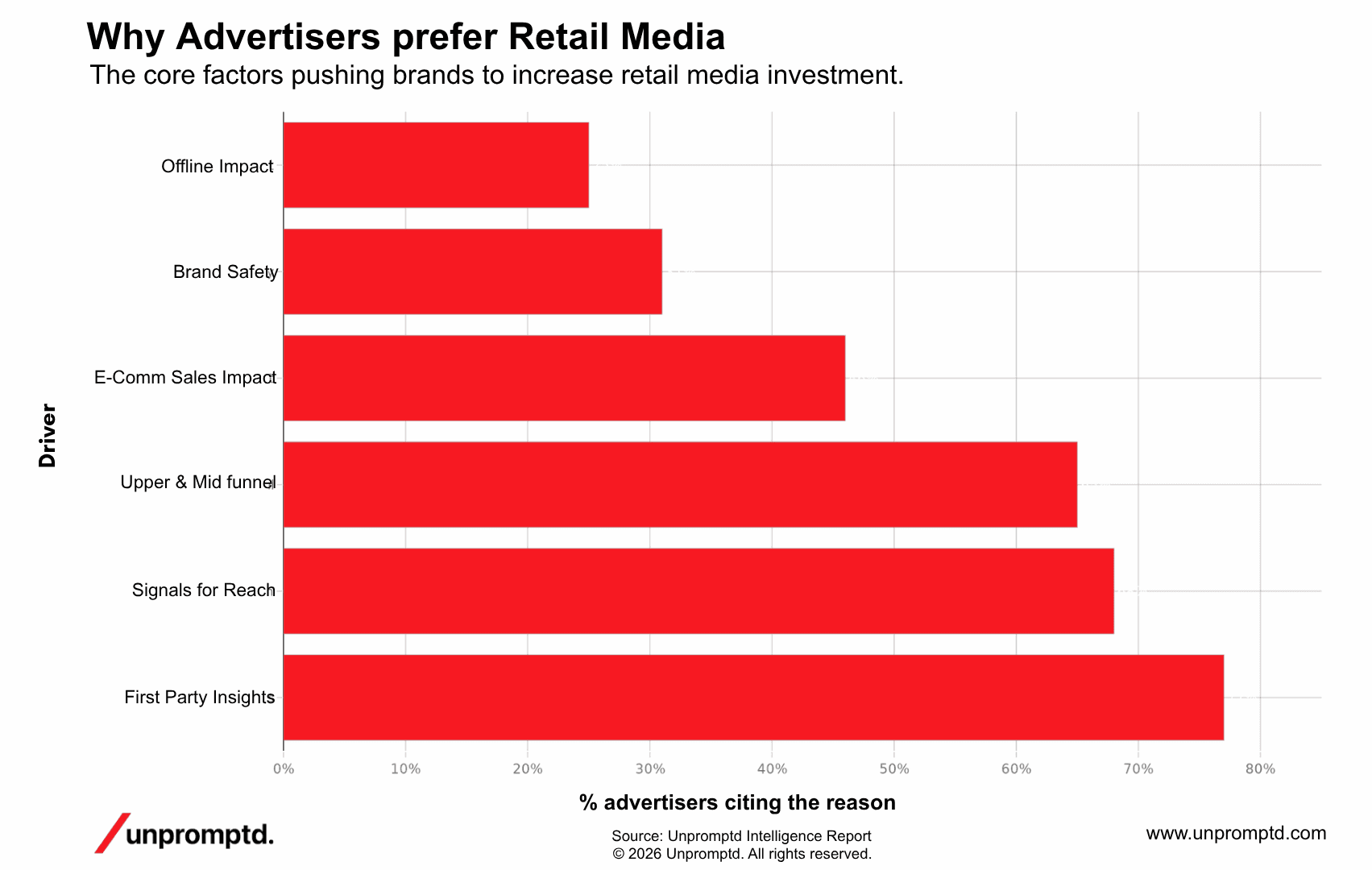
Retail media has emerged as the third major wave of digital advertising after search and social. In India and Southeast Asia, it has quickly moved from an experimental line item to a core part of media plans. Budgets are rising, new retail media networks are launching frequently, and commerce teams now influence media strategy more than ever.
Yet despite this growth, measurement remains the biggest challenge. This article explores why retail media is growing so quickly, what is driving that growth, and why measurement is becoming the key constraint for the next phase of scaling.
Why Retail Media Is Exploding in India & SEA
Three structural forces are accelerating retail media adoption: the decline of third-party identifiers, the search for performance close to transactions, and retailers’ push for higher-margin revenue streams.
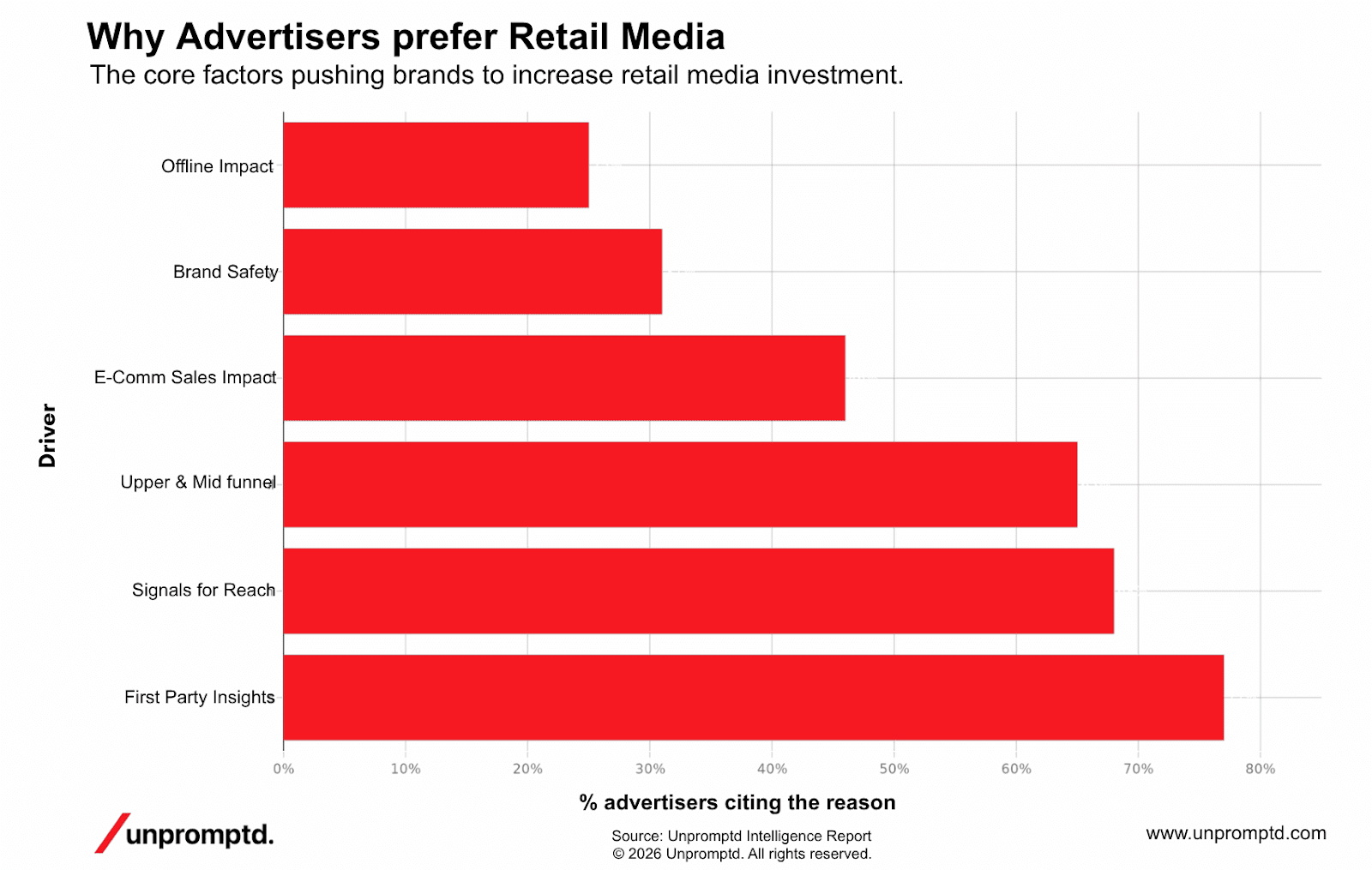
1. First-Party Commerce Data in a Post-Cookie World
As third-party cookies disappear and mobile IDs become harder to use, marketers are searching for privacy-resilient targeting solutions. Retailers hold exactly what brands need: logged-in users, transaction-level data, and high-intent browsing signals.
In India, brands are shifting budgets from open-web display to ecommerce platforms where impressions can be linked directly to purchases. Marketers increasingly describe this as moving from “signal loss” on the open web to “signal gain” inside retail ecosystems.
In Southeast Asia, large marketplaces and super apps such as Shopee, Lazada, Grab, and Tokopedia serve a similar role. These platforms combine discovery and transactions, making them powerful environments for performance advertising.
2. High Purchase Intent and the “Last Mile” of the Funnel
Retail media reaches consumers when they are actively shopping, browsing products, searching categories, or adding items to their cart. This proximity to purchase shortens the path from ad exposure to transaction.
Sponsored listings, on-site display, and in-app placements allow marketers to move users from consideration to purchase in just a few clicks. For performance-driven teams under pressure to demonstrate ROI, this “last-mile” advantage is extremely valuable.
Importantly, retail media is also expanding beyond the bottom of the funnel. Networks now offer video, display, connected TV, and in-store screens, allowing brands to run awareness and mid-funnel campaigns within retailer ecosystems.
3. Retailers Turning Data Into a Margin Engine
Retailers across India and Southeast Asia operate with thin product margins, and media monetization helps improve profitability.
By selling sponsored listings, homepage placements, CRM audiences, and other ad formats, retailers create a high-margin revenue stream that complements ecommerce sales. This is why nearly every major marketplace and large retailer is building a retail media network.
The result is a powerful dynamic:
marketers want better targeting and attribution, while retailers want new revenue streams.
Together, these forces are driving one of the fastest-growing channels in digital advertising.
Why Measurement Isn’t Keeping Up
Despite its advantages, many marketers remain uneasy about retail media measurement. The way retail media is measured has not caught up with the way it is bought.
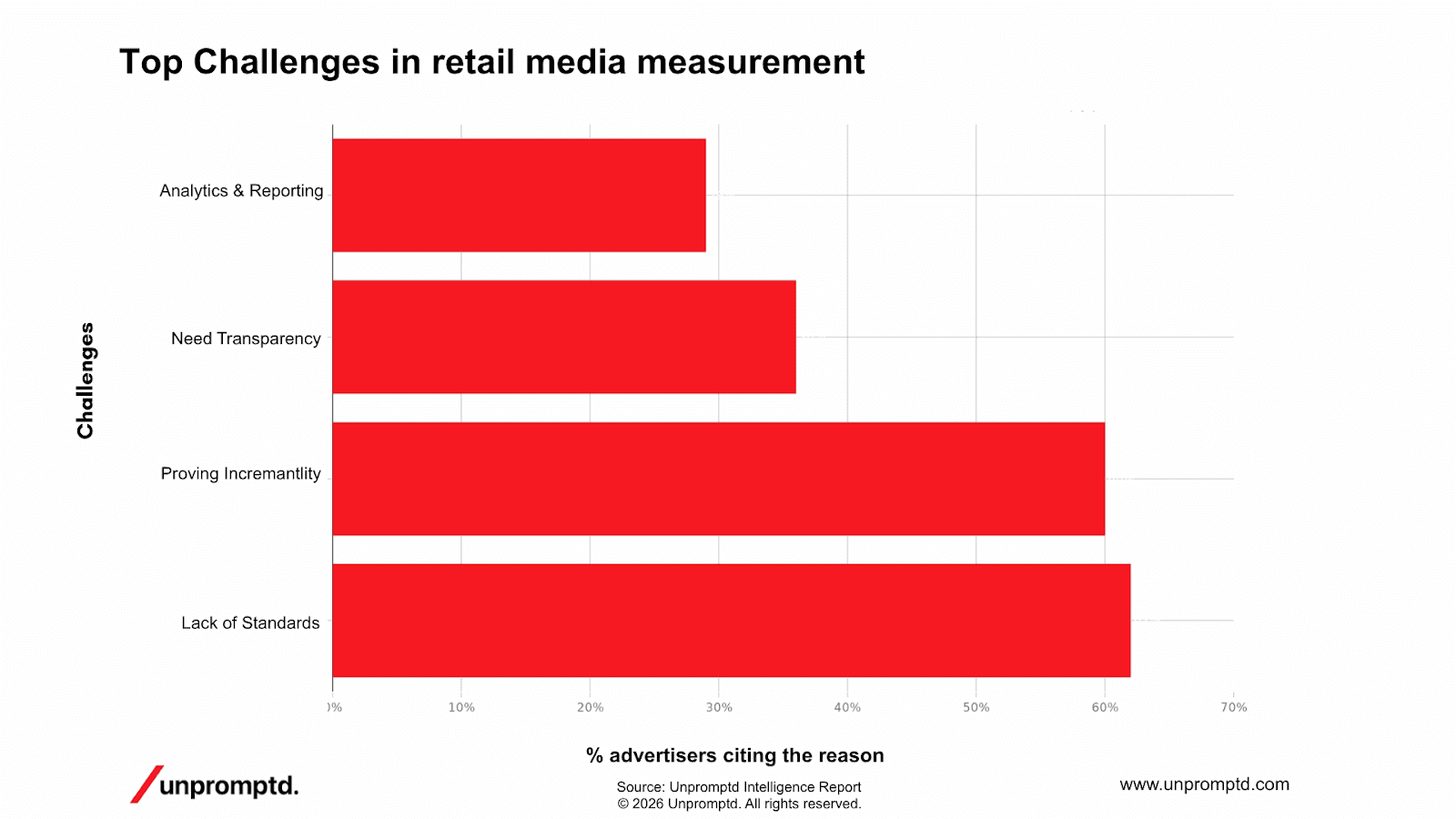
Across India and Southeast Asia, four structural challenges consistently appear.
1. Fragmented Standards and Walled Gardens
Each retail media network defines its own metrics, attribution windows, and reporting logic. Even metrics such as ROAS, “new-to-brand,” or share of voice can vary significantly across platforms.
For brands advertising across multiple marketplaces, this creates major challenges:
Different definitions and attribution windows
Limited transparency into auctions and audiences
Difficulty comparing performance across networks
As a result, marketers often optimise within each platform rather than across their entire media mix.
2. Incrementality Is Hard to Prove
Retail media dashboards often show very strong ROAS numbers, but those numbers do not always reflect true incremental growth.
Common issues include:
Ads capturing users who already intended to buy
Double counting across search, social, and retail ads
Limited use of holdout groups or geo experiments
Without proper testing frameworks, brands risk over-investing in channels that appear efficient but generate little incremental value.
3. Cross-Channel Attribution Is Still Immature
Retail media rarely operates alone. A purchase might involve:
Discovery through social media
Research via search
Conversion on a retail platform
However, retail media reporting often attributes the sale to the last interaction inside the retailer’s ecosystem, ignoring earlier marketing touchpoints.
In India and Southeast Asia, where consumers frequently move between online and offline channels, this problem becomes even more complex.
Without approaches like Marketing Mix Modeling (MMM) or Multi-Touch Attribution (MTA), marketers often give excessive credit to the channels with the most detailed reporting.
4. Organisational Silos
Retail media also sits across multiple teams:
Trade marketing
Brand marketing
Ecommerce and performance teams
Sales and account management
Each team has different objectives and KPIs. Without a unified measurement framework, organisations often end up with fragmented decisions and short-term optimisations rather than long-term learning.
What the Data Is Telling Us
Two realities exist at the same time.
On one hand, marketers value retail media because of its first-party data, purchase intent signals, and ability to combine performance and branding.
On the other hand, industry research consistently highlights measurement complexity, limited transparency, and lack of incrementality proof as major barriers to scaling investment further.
In simple terms:
Retail media is not just a fast-growing channel.
It’s a fast-growing channel where measurement is now the bottleneck.
How Brands Can Close the Measurement Gap
Marketers in India and Southeast Asia can take three practical steps.
1. Standardise Data Across Networks
Create a network-agnostic data model with consistent naming conventions and normalized metrics across retail media platforms. Even if networks operate differently, this improves cross-platform comparisons and decision-making.
2. Make Incrementality Testing Standard Practice
Brands should move beyond occasional lift studies and implement regular experiments such as:
Geo-split tests
Audience holdouts
On/off campaign testing
Incrementality should become the default lens for evaluating retail media investment.
3. Integrate Retail Media Into Broader Measurement
Retail media should be evaluated alongside search, social, TV, and trade marketing. This means incorporating retail media data into Marketing Mix Modeling, attribution frameworks, and CRM-based measurement systems.
The goal is to shift from platform-centric reporting to business-centric measurement.
At Unpromptd, we do not just open doors. We help you own the room. --- If you are a global platform looking to enter or expand in Asia, reach out to us at contact@unpromptd.com. Let’s build the future together.
