
Unpromptd Team
The Metric Shift: Why Reach-Based Advertising Is Dying and Intent-Based Is Taking Over
For more than a decade, digital advertising ran on a simple, almost comforting belief: if you can reach more people, you will inevitably sell more products. That’s why brands poured money into banner ads, programmatic display, broad social reach campaigns, and video pre-roll. The logic seemed bulletproof. More eyeballs meant more opportunities. More opportunities meant more conversions. And conversions meant growth.
But in 2026, that old logic is collapsing.
Not because advertising has stopped working, but because the internet itself has changed. Attention is no longer scarce. People are online all the time. The scarce resource now is something far more valuable than reach: intent. The ability to catch a customer at the exact moment they are ready to buy, not when they are simply scrolling.
This is the shift reshaping the entire performance marketing industry. Reach-based budgets are shrinking fast. Intent-led channels are taking over. And the performance gap between the two has become so massive that continuing to run reach-heavy strategies is starting to look like paying for noise.
Why Reach-Based Advertising Worked (Until It Didn’t)
Reach-based advertising dominated because it made perfect sense in the early days of digital. Platforms were cheaper, ad inventory was less crowded, and people hadn’t yet developed strong resistance to ads. Brands could run large campaigns at low CPMs and still see results even when the conversion rates were small.
The math looked great on spreadsheets. If you could reach 10 million people for $10,000 and convert even 0.1%, that’s 10,000 customers. Scale it up, and it felt like digital was a growth cheat code.
But the weakness in that system was always there: most impressions were wasted. The human brain adapts quickly. Over time, consumers trained themselves to ignore ads they didn’t ask for. This is the phenomenon marketers know as banner blindness, the natural tendency to filter out promotional content while browsing.
So reach-based ads kept getting served, but fewer people noticed them, fewer people clicked, and fewer people bought. The industry understood the leak, but there wasn’t a scalable alternative. Until now.
Intent-Based Advertising: Ads That Match What People Already Want
Intent-based advertising works because it targets users who are already showing buying signals. These signals can be obvious, like someone searching “best running shoes” on Google or browsing smartphones on a marketplace, or more subtle, like reading category-specific content or repeatedly viewing product pages.
The difference is psychological. Reach-based advertising interrupts people. Intent-based advertising answers them.
Reach-based marketing says: “Here’s an ad. Maybe you want it.”
Intent-based marketing says: “You’re already looking for it. Here it is.”
That single difference explains why the performance metrics between the two are now diverging so sharply. Intent-based impressions are not just seen more they are acted upon more.
The Budget Shift Isn’t a Trend - It’s a Migration
The clearest evidence that this is real is budget movement. Marketing budgets usually don’t change direction quickly unless something fundamental breaks. Yet over the last 18 months, that’s exactly what has happened.
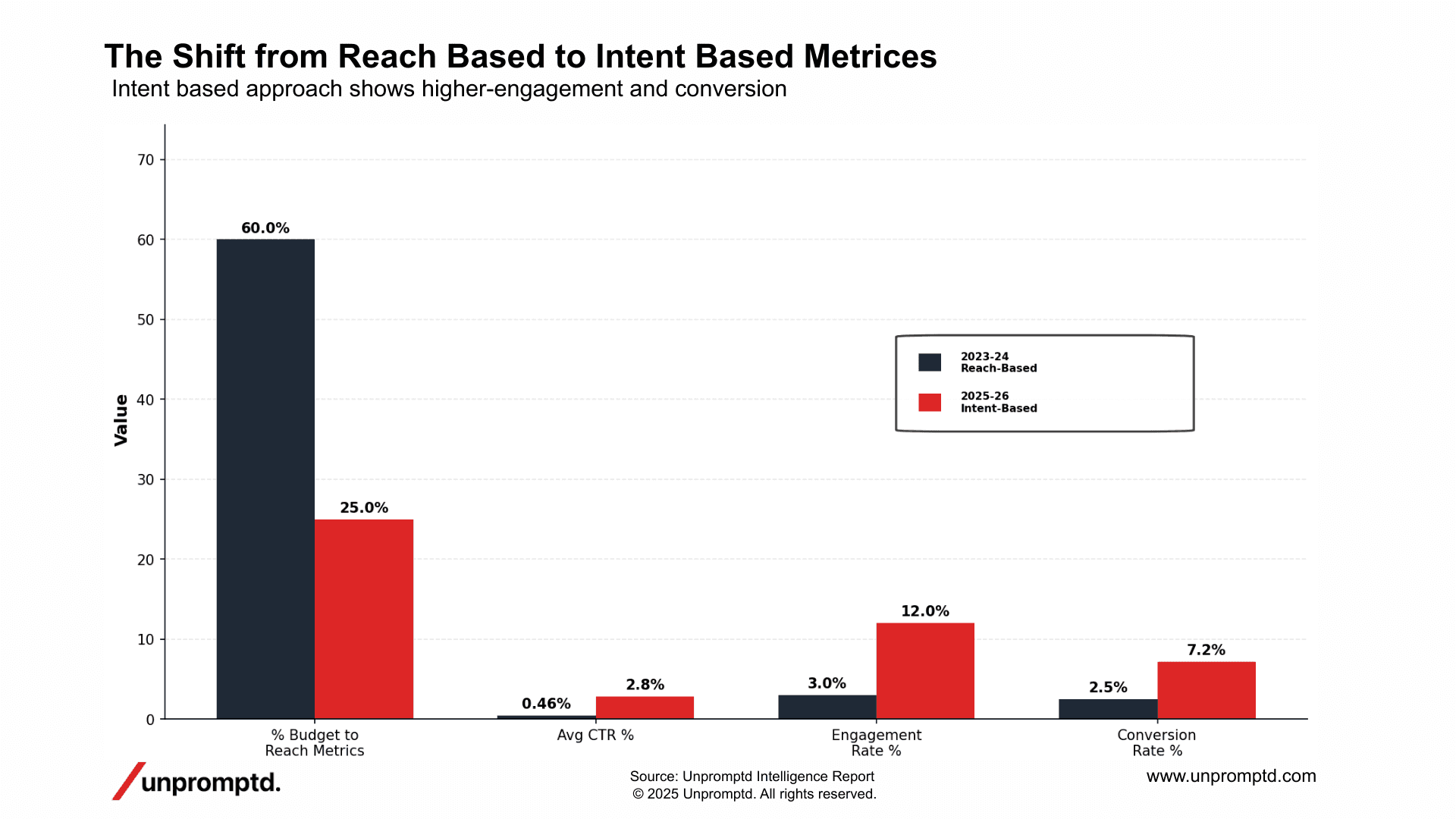
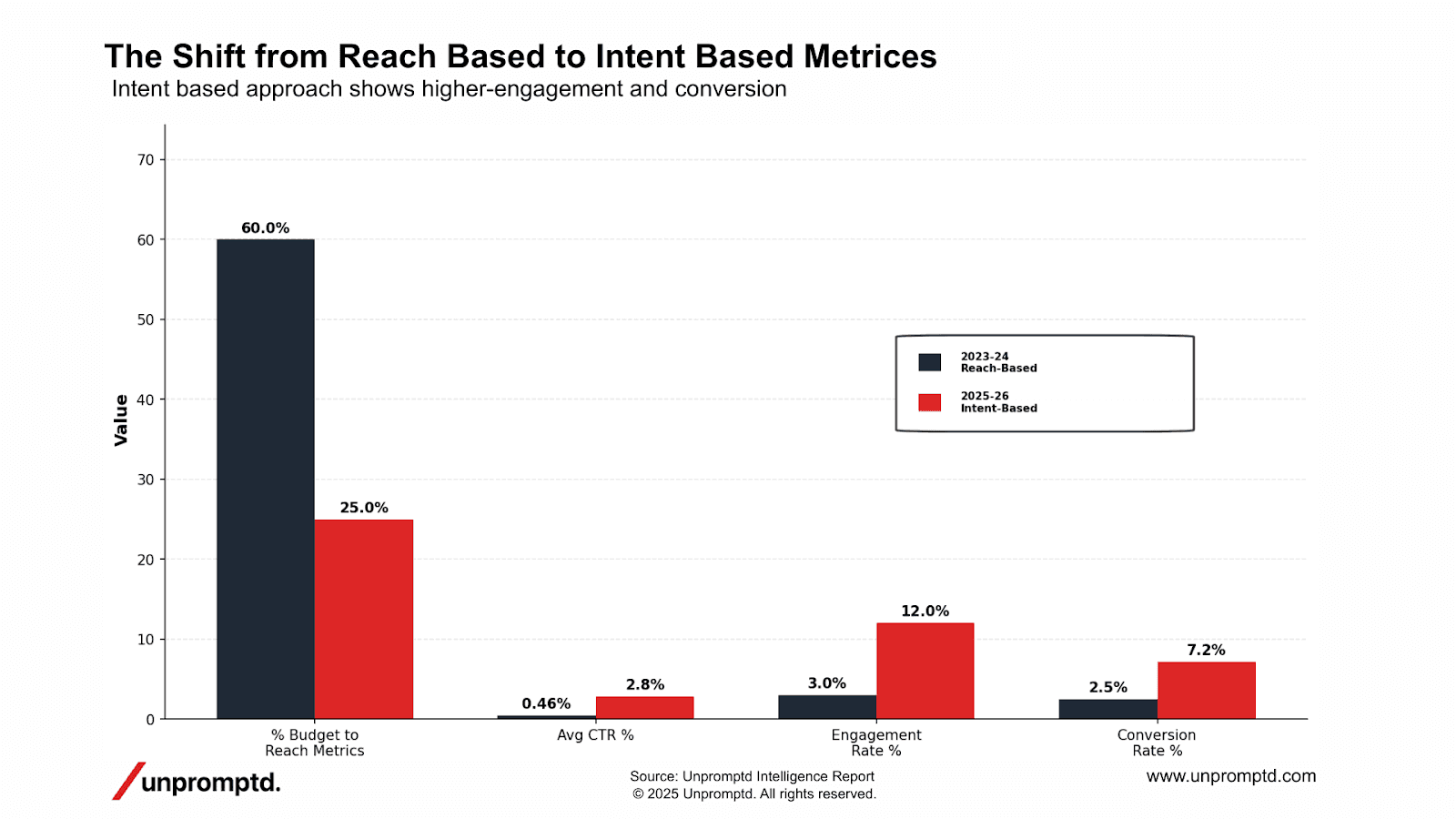
In the 2023–2024 period, the industry still looked like a reach-driven world. Roughly 60% of advertising budgets were allocated to reach-based initiatives, broad display, wide social targeting, and impression-heavy campaigns. By 2025–2026, that share drops to around 25%, meaning the industry is effectively pulling money out of reach-led advertising at historic speed.
That is not a slow evolution. That is a structural exit.
The Performance Gap Has Become Impossible to Ignore
What’s driving this budget migration isn’t just theory, it's performance reality. When you compare reach-based channels against intent-led channels, the improvements are not incremental. They are multiplicative.
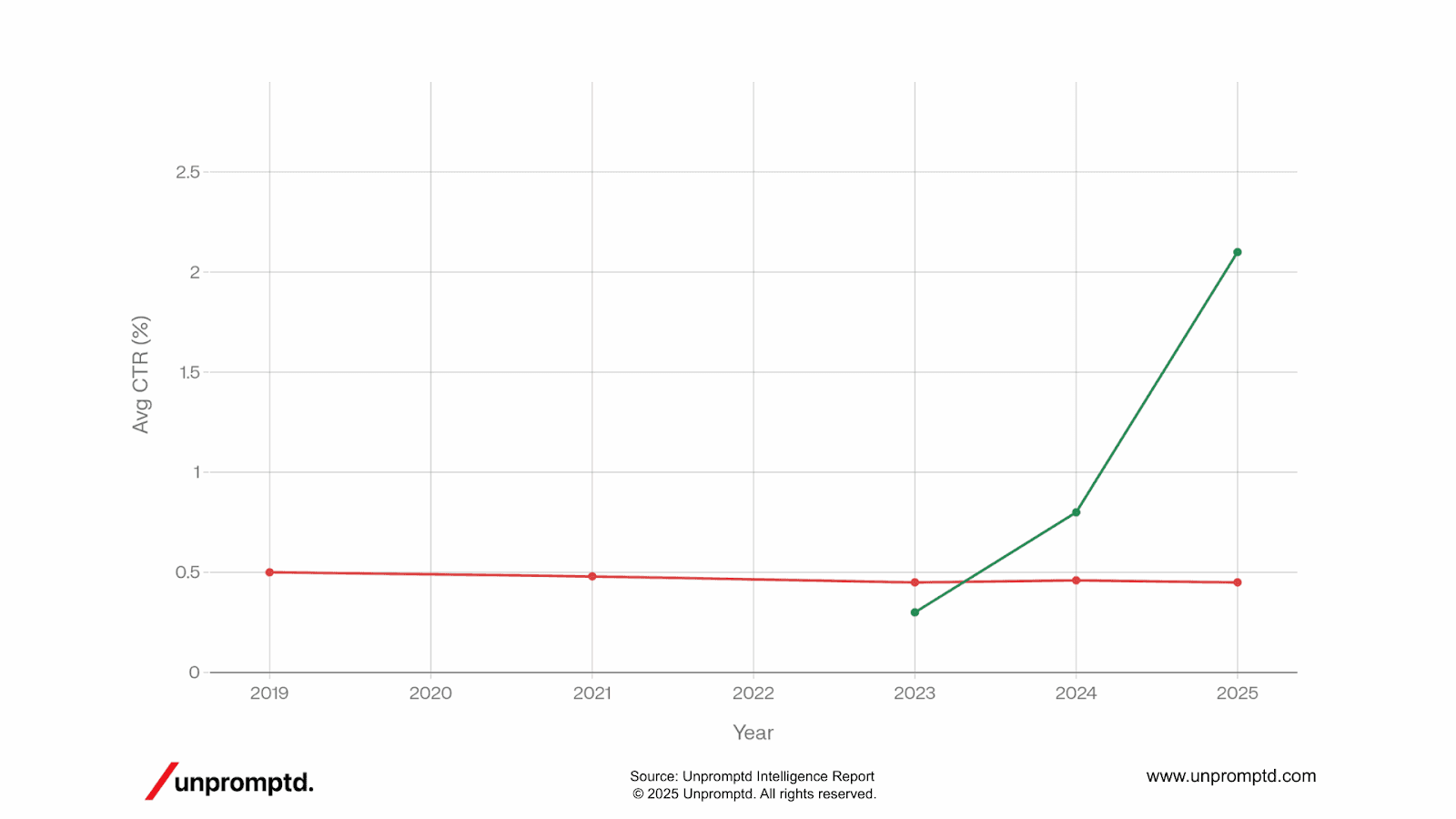
Average click-through rate (CTR) on reach-based campaigns sits around 0.46%, which is typical of broad display and non-intent social reach campaigns. That means less than 1 in 200 users clicks. Intent-based campaigns, in contrast, are producing 2.8% CTR, which is over 6× higher.
Engagement rates tell a similar story. Reach-based campaigns average around 3% engagement, while intent-driven campaigns deliver closer to 12%, a clean 4× improvement. Even more importantly, conversion rates jump from 2.5% to 7.2%, meaning intent-based campaigns convert at nearly 3× the rate of reach-driven traffic.
These numbers don’t represent creative tweaks or better targeting. They represent an entirely different mindset: one strategy buys attention, the other buys decision-making moments.
The CFO Math: Why Intent Wins on Profitability
Performance marketing ultimately isn’t judged by CTR. It’s judged by the economics it produces. So let’s translate this shift into unit economics.
Assume a simple business case. A product has an average order value of $100 and operates at a 40% margin, meaning the business can afford a maximum customer acquisition cost (CAC) of $60.
Now run reach-based economics. If CPM is $5, CTR is 0.46%, and landing page conversion rate is 5%, your cost per acquisition ends up around $217. At that CAC, you’re losing money on every customer. You’re paying $217 to earn $100.
Now run intent-based economics. Even if CPM rises to $8, CTR improves to 2.8%, and conversion improves to 15% because traffic is higher intent. That brings acquisition cost down to roughly $19.
That is the moment the shift becomes obvious. Intent-led channels don’t just perform better, they unlock profitability and scalability.
Intent Doesn’t Win by 10% - It Wins by Multiples
The easiest way to understand how wide this gap is: compare outcomes at the same spend.
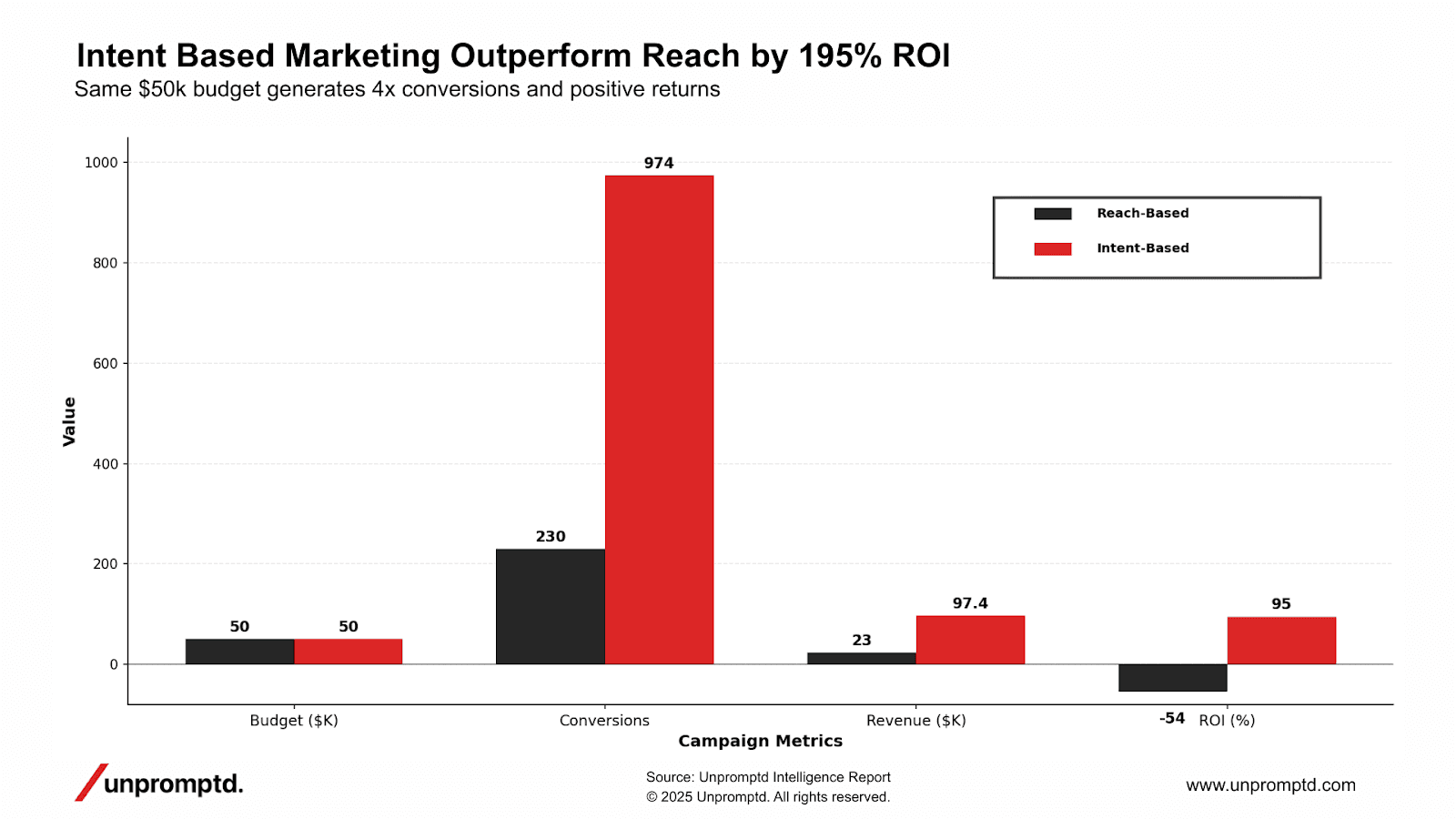
With the same $50,000 budget, reach-based display produces far fewer conversions, weaker revenue, and negative ROI. Intent-based multi-channel campaigns, on the other hand, generate significantly higher conversion volume and deliver positive returns.
This is why brands aren’t “experimenting” with intent anymore. They’re rebuilding their budgets around it.
What This Means Across Business Types
For e-commerce companies, this shift is almost brutal. Retail media networks and marketplace ads represent intent at its purest form, users already shopping, comparing, and ready to transact. In that environment, the same message converts far better than it ever could inside a passive scroll feed. The brands winning in e-commerce are increasingly those allocating more than half their digital budget toward search and retail media rather than broad social reach.
For SaaS companies, intent is even more critical. SaaS buying journeys involve research, comparisons, alternatives, and problem-solving. Reach campaigns might create awareness, but intent channels create pipelines. A user searching “best CRM for startups” is far more valuable than a user watching content that happens to include a software ad.
For offline retail, reach still matters because physical presence relies on awareness. But even here, intent-led inventory is expanding rapidly through retail media and location-based purchase paths, meaning businesses that blend local reach with high-intent digital capture will win more efficiently.
And for startups, intent is the biggest opportunity. Reach-based advertising requires scale to overcome inefficiency. Intent-based advertising can be profitable at low spend. That means startups can now compete with larger players by being smarter, not louder.
The Playbook: How to Shift Without Burning Your Funnel
The smartest way to shift from reach-first to intent-first isn’t to flip everything overnight. It’s to treat marketing like a portfolio.
Start by auditing CAC by channel. Most brands are surprised by what they discover here. Then identify intent-led opportunities for your category: search, retail media, contextual placements, and in-market segments. Test with 10–15% of your budget for 4–6 weeks, measure outcomes properly, and scale what works quarterly.
The goal isn’t to kill reach entirely. Reach still matters for brand building and awareness. The goal is to stop treating reach as the engine of conversion, because in 2025, it no longer is.
Where This Is Going Next (2026–2028)
The next phase is consolidation. By 2026–2027, most brands will complete this shift. By 2027–2028, intent-based inventory will become crowded, and early movers will have captured cheaper costs, stronger learning models, and better first-party feedback loops.
By 2028, the market will likely split into three groups. The efficient advertisers will run 70–80% intent-led budgets with reach supporting brand building. The competitive middle will operate on a balanced mix. And the laggards will remain reach-heavy, unable to scale profitably because they are overpaying for low-intent attention.
Final Takeaway
Reach-based advertising gave digital marketing its first era of growth. But its economics are breaking under the weight of overexposure and consumer blindness.
Intent-based advertising is not the future because it’s trendy. It’s the future because the math works.
Budgets are shifting from 60% reach-led strategies to 25% in less than two years. CTR improves more than 6×. Conversion rates nearly triple. And cost per acquisition can collapse from $200+ levels to under $20 in high-intent scenarios.
The future of performance marketing isn’t about reaching more people.
It’s about reaching the right people at the right moment.
Reach created the past 15 years. Intent will shape the next 15.
At Unpromptd, we do not just open doors. We help you own the room. --- If you are a global platform looking to enter or expand in Asia, reach out to us at contact@unpromptd.com. Let’s build the future together.
